
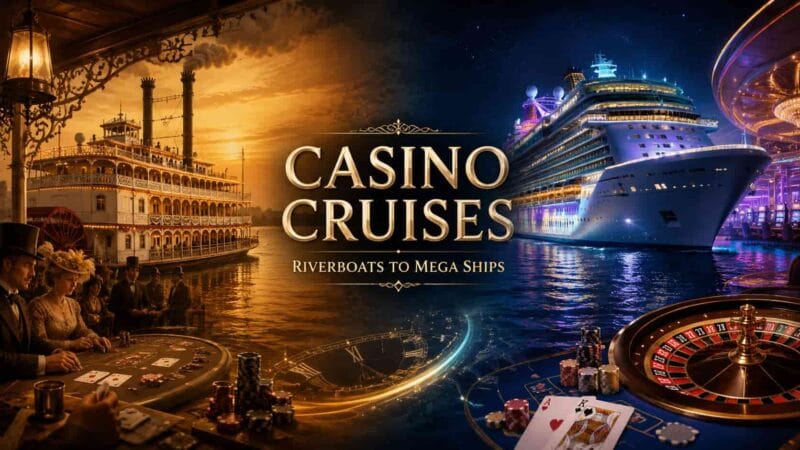
The History of Casino Cruises: From Riverboats to Mega Ships
The history of casino cruises began long before modern cruise ships added neon-lit gaming floors and loyalty programs.
In the United States, the idea grew from 19th-century river travel, especially on the Mississippi River, where steamboats carried passengers, cargo, entertainers, merchants, and gamblers between busy river towns.
Riverboat gambling developed during the 1830s as steamboat traffic expanded through the Mississippi Delta.
Towns such as Cairo, Hickman, and Helena grew around river commerce, while larger cities including Memphis, Vicksburg, Natchez, and Baton Rouge became linked to the steamboat era.
Why Riverboats Became Gambling Venues
Riverboats became gambling venues because they offered movement, privacy, entertainment, and access to passengers with money to spend.
Long journeys created demand for card games and social activities, while the river itself made gambling feel separate from everyday town life.
In many places, gambling on boats existed in legal gray areas. Authorities could restrict land-based gambling more easily than games played on vessels moving between jurisdictions.
This tension between regulation and mobility became one of the defining themes of casino cruises.
The Return of Legal Riverboat Casinos
Legal riverboat casinos returned in a major way in the late 20th century. Iowa passed legislation on July 1, 1989, allowing licensed gambling games on excursion gambling boats in counties where voters approved them by referendum.
The Iowa Racing and Gaming Commission later granted licenses in 1990, and several boats began operating in 1991, including the Dubuque Casino Belle, Diamond Lady, and President.
This model spread because it gave states a compromise: gambling could generate jobs, tourism, and tax revenue, while still being limited to specific waterways or approved locations.
Over time, some riverboat casinos stopped cruising regularly and became permanently moored or land-based gaming structures, but the riverboat image remained powerful.
Ocean Casino Cruises and International Waters
Ocean casino cruises expanded the same idea onto a larger stage. Instead of rivers, operators used the sea; instead of short local excursions, passengers could sail beyond domestic gambling restrictions.
The legal foundation is tied to maritime zones. In the United States, NOAA identifies the territorial sea as extending 12 nautical miles from the baseline, with other zones beyond it.
Within territorial waters, coastal-state rules can apply; beyond them, cruise operators generally depend on flag-state law and international maritime rules.
Because of this, modern cruise ship casinos usually open only after the ship reaches international waters and close while docked in port, except in limited destinations where local rules allow gaming.
Royal Caribbean states that its ship casinos must close in port with few exceptions and operate in international waters.
The “Cruise to Nowhere” Era
The “cruise to nowhere” became a popular format for passengers who wanted a short gambling-focused trip without a traditional destination.
These cruises typically sailed into international waters and returned to the same port without calling at another country.
In the United States, that model changed after immigration and crew-status rules were enforced more strictly.
Cruise Critic reports that, as recently as 2015, passengers could still book cruises to nowhere from ports such as New York, but a 2016 U.S. Customs and Border Protection position effectively ended these trips for foreign-flagged ships sailing from U.S. homeports.
From Card Rooms to Full Casino Floors
Casino cruises evolved from small card rooms into full entertainment zones. Today’s mainstream cruise casinos often include slot machines, roulette, poker-style games, dice tables, tournaments, promotions, and player reward programs.
Royal Caribbean describes Casino Royale as a Las Vegas-style venue available across its ships, with slot machines, table games, tournaments, and rewards.
This shift changed the purpose of onboard gaming. Gambling was no longer just a side activity during travel; it became part of a broader vacation economy that includes dining, shows, shopping, spas, bars, private islands, and loyalty perks.
The same guest may spend the day at a pool, attend a theater show, and later compare a table-game experience with blackjack online, all without leaving the ship.
Mega Ships Changed Casino Cruises Forever
Mega ships changed casino cruises by turning vessels into floating resorts.
Royal Caribbean says the real mega-ship revolution arrived in 2009 with Oasis of the Seas, then the largest cruise ship ever built and the first to feature themed “neighborhoods” such as Central Park, the Boardwalk, and the Royal Promenade.
Newer ships pushed the concept even further. Royal Caribbean’s Icon Class, including Icon of the Seas and Star of the Seas, is described by the company as part of the world’s biggest cruise ship category, designed as an all-in-one vacation with major attractions, family neighborhoods, thrill areas, and large-scale entertainment.
On these ships, the casino is one attraction among many, not the only reason to sail.
That is the biggest difference between early riverboats and modern mega ships: gambling once defined the journey, while today it supports a much larger resort experience.
The Legacy of Casino Cruises
Casino cruises have always reflected the relationship between entertainment, law, travel, and technology. Riverboats used waterways to create flexible gaming spaces.
Ocean cruises used international waters to expand the model. Mega ships transformed the casino into one part of a complete vacation ecosystem.
The story of casino cruises is therefore not only about gambling. It is about how operators adapted to changing laws, passenger expectations, ship design, and tourism trends.
From Mississippi steamboats to record-breaking cruise ships, casino cruising has remained successful because it combines movement, escape, risk, and spectacle in one memorable experience.
Read on for Even More Vacay Inspo:
- Orlando Resort Pools Locals Can Actually Use with Spa + Day Passes
- Travel Trend: Orlando Couples Love House Swapping
- 50 Fun Ideas and Awesome Things to Do This Summer in Orlando
*Presented by: Bazoom Group